Your managers may be running their departments. But you may still be the only person managing the whole business.
You hired managers because the business had grown beyond what one person could comfortably oversee. You needed someone to lead Sales, someone to keep Operations moving, and someone to watch cash and controls. You wanted a team that could manage employees without every question, complaint, and performance issue ending up on your desk.
On paper, the structure looks better. Employees who once reported directly to you now report to managers. Departmental meetings happen without you. Managers prepare reports, assign work, and make decisions within their functions.
Yet your calendar is still full. Your phone still interrupts you. Management meetings still end with several actions assigned to you. You are still called when Sales and Operations disagree, when Finance refuses a supplier payment, when a customer promise cannot be fulfilled, or when an important project is moving inside several teams but reaching completion in none of them.
You may find yourself wondering: “What exactly changed when I hired managers?”
Your managers are likely working hard. They know their departments well and deliver respectable departmental results. The problem isn't that they are doing nothing. The problem is that you hired managers to own different parts of the business, but you remained responsible for joining those parts together.
The management meeting that still creates work for you
Imagine a familiar management meeting. The Sales Manager explains that a VIP customer was promised delivery by Friday. The Operations Manager says Friday is unrealistic because the order requires materials they don't have. The Finance Manager says emergency purchasing cannot be approved because that same customer has an overdue balance. The Customer Service Manager says another delay will permanently damage the relationship.
Each manager has a reasonable position. Sales is protecting revenue, Operations is protecting quality, Finance is protecting cash, and Customer Service is protecting the relationship. Nobody is necessarily being careless or refusing to take responsibility.
But the issue still lands with you. You have to understand the commercial value of the customer, the operational risk, the cash position, and the long-term effect on the relationship. You decide which concern matters most. You decide which department should adjust. You decide what the customer will be told. And you will probably have to check later to ensure the decision was actually implemented.
The business has managers. But when several functions must act as one business, you are still the management system. This is a different form of founder dependency. It is not that employees depend on you for instructions; it is that your managers depend on you to integrate their work.
Vertical supervision vs. Horizontal coordination
Most growing businesses introduce management roles vertically. The Sales Manager becomes responsible for the sales team, Operations for delivery, and Finance for controls. The reporting lines are clearer.
But customers, projects, and business results do not move vertically through an organization chart. They move across it. A customer begins with Marketing, speaks to Sales, is handed to Operations, receives an invoice from Finance, and returns through Customer Service when something goes wrong.
When your business was smaller, integration happened almost automatically because so much information sat in your head. You knew what was promised, the available cash, and which supplier could help. As the business grew, that picture was divided among your managers. But dividing information and responsibility does not automatically create a shared view.
Someone still has to connect the parts. Adding managers doesn't just create management capacity; it creates more points at which information and decisions must move between functions. You may spend less time supervising individual employees, but you now spend more time reconciling departmental priorities, resolving failed handovers, and breaking deadlocks. You are no longer managing all the people. You are managing all the connections.
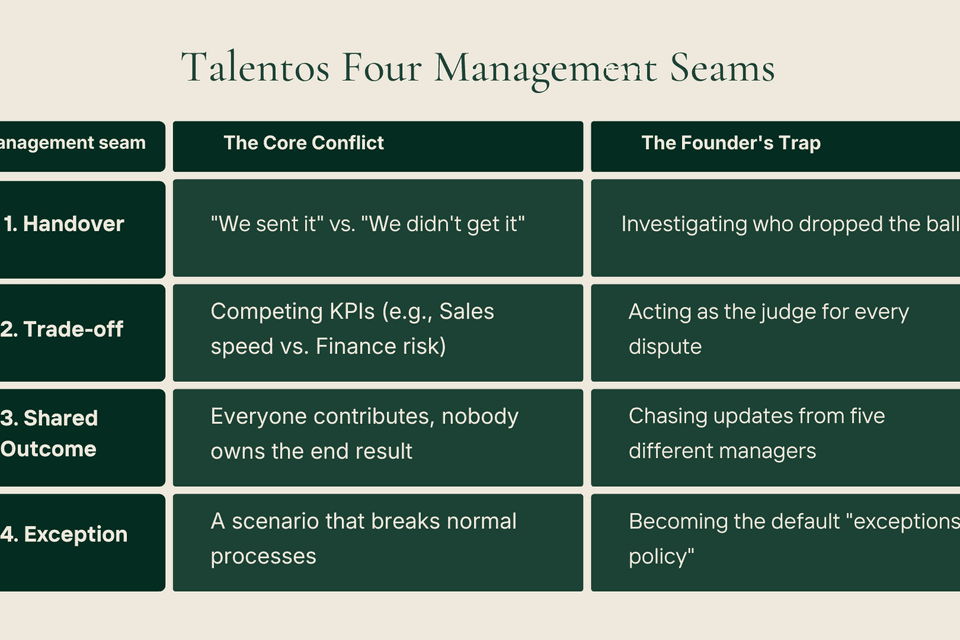
The Four Management Seams
The greatest pressure on the founder always appears at what we call management seams, the points where one manager’s work meets another manager’s work. Inside a department, responsibilities are relatively clear. At the seam, responsibility blurs.

1. The Handover Seam
A handover fails even when both departments believe they have done their work. Sales says, "We sent the customer requirements." Operations says, "The requirements were incomplete." Operations says, "The work is done." Finance says, "Nobody sent the documents needed for invoicing."
Many businesses treat a handover as complete when information has been sent (an email forwarded, a document uploaded, a WhatsApp message sent). But sending information does not prove the receiving department understood what was expected, accepted responsibility, or had the capacity to act. A handover is complete when the receiving person can act—not when the sending person has sent something.
2. The Trade-off Seam
A trade-off occurs when two managers are responsible for outcomes that cannot be maximized at the same time. Should the company accept an urgent order that disrupts the production schedule? Should Finance release money for an unplanned purchase to protect a strategic relationship?
These are often conflicts between legitimate business priorities. But when the organization has no agreed way to resolve predictable trade-offs, every disagreement moves upward. Every exception becomes a founder decision.
3. The Shared-Outcome Seam
Some outcomes require several departments but belong fully to none of them. Think of customer retention, onboarding a new employee, collecting overdue revenue, or launching a new service. Each department can explain what it has done, but the outcome remains unfinished.
A manager can contribute to an outcome without owning it. The founder becomes involved because the business distributed the activities without appointing someone to carry the complete result. Activity exists everywhere. Complete ownership exists nowhere.
4. The Exception Seam
Processes describe what should normally happen. Exceptions are the situations that don't fit neatly within those processes, an important customer requests unusual payment terms, or a key supplier fails right before a deadline.
Managers may run normal departmental work competently but freeze when an exception crosses several functions. When the business hasn't decided how cross-functional exceptions should be handled, the founder becomes the standing exception process.
How to build one business, not several departments
Hiring functional managers is one stage of growth. Building a management team is another. A collection of managers becomes a team when they can look beyond the interests of their departments and jointly carry business outcomes. That requires a different operating discipline.
- Give shared outcomes one end-to-end owner. Name one person responsible for carrying a cross-functional outcome to completion. They don't perform all the work; they are responsible for keeping the whole result visible, asking where the dependencies are, and surfacing risks before they derail the project.
- Design important handovers. Do not leave recurring handovers to individual habit. Identify the exact information, standard, and confirmation required when work crosses departments. Start with the handovers that repeatedly create customer delays or require your intervention.
- Agree how predictable trade-offs will be resolved. Establish principles that guide the managers. What level of delay requires customer escalation? Which payment exceptions can managers approve together? The goal is to stop the exact same unresolved trade-off from returning to your desk in a slightly different form every week.
- Use shared evidence, not separate departmental stories. For important shared outcomes, managers need a common view—like a simple shared tracker showing the current status, dependencies, and owners. The goal is not more reporting; it is less interpretation and reconstruction by the founder.
- Expect manager-to-manager resolution. Managers should not use you as the first communication channel between departments. Before escalating an issue, they should speak directly, confirm the facts, assess options, and develop a joint recommendation. Your involvement should add founder-level judgment, not force basic coordination.
Final Thought
You did not hire managers only to create smaller groups of employees. You hired them so that the business could develop management capacity beyond you.
That capacity is not complete when each manager can run a department independently. It becomes complete when the managers can also manage the relationships, dependencies, and trade-offs that connect their departments. Your managers may already know how to lead downwards. The next stage is learning to manage sideways.
Until that happens, every department may have an owner while the founder remains the only person who owns the whole business. The question is no longer just, “Are my managers doing their jobs?” It is, “Can they make the business work together without requiring me to reconnect it every time?”