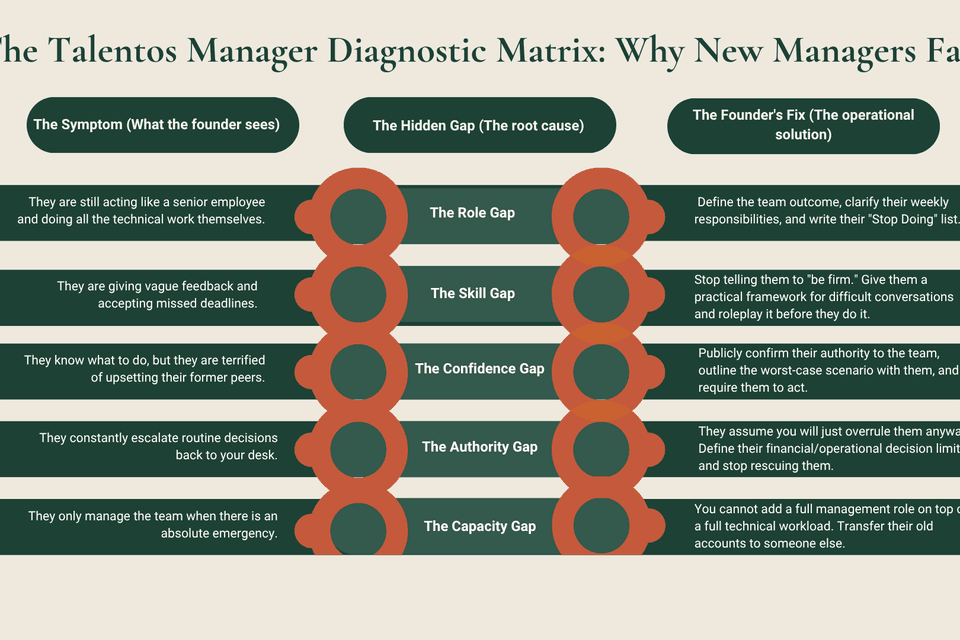
By the third month after the promotion, the founder starts to doubt the decision.
The new manager is still personally handling the largest customer accounts. They quietly correct their employees’ work instead of returning it with feedback. They avoid confronting a former peer who is missing deadlines. And they still ask the founder for approval on decisions that were supposed to move off the founder's desk.
When the pressure rises, they stop managing the team entirely and revert to being its strongest employee.
Eventually, the founder calls them into a meeting and delivers the standard script:
- "You need to delegate more."
- "You have to hold people accountable."
- "Stop waiting for me."
- "You need to start thinking like a manager."
The new manager listens. They agree. They feel embarrassed. But they leave the meeting without knowing what to actually do differently the next time an employee misses a commitment or a customer issue becomes urgent.
The founder believes they have just coached the manager. In reality, they have only described their disappointment.
This is one of the most consequential mistakes a growing business can make. A strong employee is promoted because they have demonstrated technical brilliance and reliability. The business then expects them to magically develop an entirely new set of capabilities through vague instruction and pressure.
A promotion creates the opportunity to manage. It does not create a capable manager.
A Strong Employee is Not an Unfinished Manager
The first mistake happens before the promotion is even announced.
The business assumes management is the natural next step for its best employees. The salesperson who closes the biggest accounts becomes the Sales Manager. The technician who solves the hardest problems becomes the Head of Service.
But management is not simply a more senior version of the previous job. It is a completely different profession.
As we established in Manager or Senior Employee?, the person is moving from being responsible for their own contribution to being responsible for the conditions in which other people contribute.
Their previous success does not prove they know how to lead former peers, delegate outcomes, or give uncomfortable feedback. A strong employee is not an unfinished manager; they are a beginner in a new discipline.
Step 1: Before You Coach, Fix the Role
Founders frequently try to coach a manager inside a role that has not been properly designed.
If the new manager is still responsible for their previous client portfolio, executing the hardest technical work, and responding whenever the founder needs a fast answer, they do not have time to manage. When technical work consumes the week, feedback waits, delegation is rushed, and the team drifts.
The founder sees weak management and prescribes "more leadership." But a role cannot absorb unlimited responsibilities through sheer encouragement.
Before asking how to coach them, ask these four questions:
- What is on their "Stop Doing" list? A promotion must remove work, not just add it.
- What team result do they own? Not their personal activity, but the team's outcome.
- What is their authority? Can they actually change schedules, correct standards, and make decisions without you? Responsibility without authority creates a spokesperson, not a manager.
- Is their time protected? You cannot demand management while preserving all the conditions that keep the person operating as an individual contributor.
Step 2: Stop Using Vague Labels
"Poor management" is too broad to coach. Founders love to use labels: "You need to be more assertive," or "You are too controlling," or "You need to be strategic."
These labels express real founder frustration, but the manager cannot practice "being less passive" in a measurable way. You must translate your frustration into observable behavior.
Instead of: "You need to be more assertive." Use: "When an employee misses a deadline, do not agree to a new date until you establish why they missed the first one and agree on a corrective action."
Instead of: "You need to delegate better." Use: "Assign the complete result to the coordinator. Do not take the work back to fix it yourself unless it breaches our escalation threshold."
Instead of: "Stop escalating everything." Use: "Make routine customer-recovery decisions within your KSh limit. Escalate to me only if the financial exposure exceeds that limit, and bring a recommendation when you do."
The Talentos New Manager Coaching Loop

At Talentos, we organize the transition from employee to manager around a six-step operational rhythm. This is not a one-time HR induction; it is how the business turns experience into actual capability.
1. Reset the Role (And Define the Evidence)
You must redefine what success looks like. Before the promotion, you praised them by saying, "You are the only one who can fix this." You rewarded personal indispensability.
Now, you must explicitly say: "I am no longer assessing you by what you personally complete. I am assessing whether the team becomes clearer, more reliable, and more capable under your management."
2. Diagnose the Exact Gap
When they fail, why did they fail?
- The Skill Gap: They don't know how to structure a feedback conversation.
- The Confidence Gap: They know what to do, but are terrified of upsetting a former peer.
- The Authority Gap: They didn't act because they assumed you would just overrule them anyway. Do not send a manager to a training course if the real problem is that you haven't given them the authority to act.
3. Prepare a Live Management Moment
Do not try to fix everything at once. Pick one real situation from their 5D Weekly Ownership Loop—like delegating an important recovery plan or confronting a missed deadline.
Before the moment, pre-brief them. Ask: "What result do you need from this conversation? What are you tempted to avoid? What will you do if they push back?" Help them think clearly, but do not give them the script. If they merely recite your words, their judgment remains dependent on you.
4. Let the Manager Lead (Without Rescuing Them)
This is where founders fail. You prep the manager, but when the meeting gets tense or moves too slowly, you step in and take over.
The immediate problem is solved, but the manager just learned three fatal lessons:
- Important situations still belong to the founder.
- The founder will rescue me when I am uncomfortable.
- Waiting for the founder is safer than exercising my own judgment.
If their decision is reasonable and within their authority, let it stand—even if it isn't exactly how you would have done it. Authority only becomes real when a manager experiences that their decisions won't be automatically reversed.
5. Debrief the Judgment
Learning happens when the manager examines the effect of their action. After the moment, ask:
- "What did the employee actually understand?"
- "Did you accidentally take back responsibility that should have stayed with them?"
- "What will you change next time?"
Give feedback on one decisive behavior, not their entire personality.
6. Expand the Ownership Boundary
Coaching should produce independence. As their judgment strengthens, transfer larger customer decisions, broader schedule authority, and less frequent reviews. The test of your coaching is not how much advice you give; it is how much sound management happens when you aren't in the room.
Final Thought
Promoting a strong employee is one of the most important bets your business makes. You are deciding who will carry the standards, operating discipline, and culture when you are not present.
That responsibility is too important to leave to trial and error.
The new manager must change—they must release the work that once made them valuable and hold conversations they previously avoided. But the founder must change, too. You must define the role, transfer real authority, and stop rewarding them for permanent rescue.
The strongest managers are not created by repeatedly being told to "act like a manager." They are created when the business gives them real management work, supports them through the painful first attempts, and steadily steps back as their judgment grows.
That is how a title becomes a capability. And that is how your business finally grows beyond you.
Are You Coaching, or Just Complaining?
Talentos helps founder-led SMEs move management capability beyond the founder. We help businesses clarify manager roles, define decision rights, and build practical coaching plans around real operational situations.
If your managers have titles but you are still setting their priorities and rescuing their clients, you have a structural problem.