At 4:47 PM on Friday, your manager sends their weekly update.
They attended four customer meetings, reviewed eleven quotations, resolved a stock issue, checked two reports, followed up on delayed deliveries, and helped an employee complete an urgent assignment.
It was an exhausting, busy week. But as you read the update, five critical questions remain unanswered:
- What did the team actually achieve?
- Which commitments were completed?
- What moved off track?
- Whose performance improved?
- Which risks still require a decision?
Your manager has successfully described their activity. They have not yet demonstrated their management.
This distinction matters because real managerial work easily disappears inside a crowded calendar. A manager can spend Monday solving an urgent customer issue, Tuesday preparing a report, Wednesday in meetings, Thursday correcting an employee’s mistakes, and Friday catching up on their own tasks. Every hour is occupied, yet priorities remain unclear, missed commitments roll over, and decisions stall.
A full calendar is the perfect place to hide an unmanaged team.
As we explained in Manager or Senior Employee?, a true manager is not defined by their personal technical output. A manager creates reliable performance through a team.
The practical question is: What must a manager repeatedly own each week for that performance to happen?
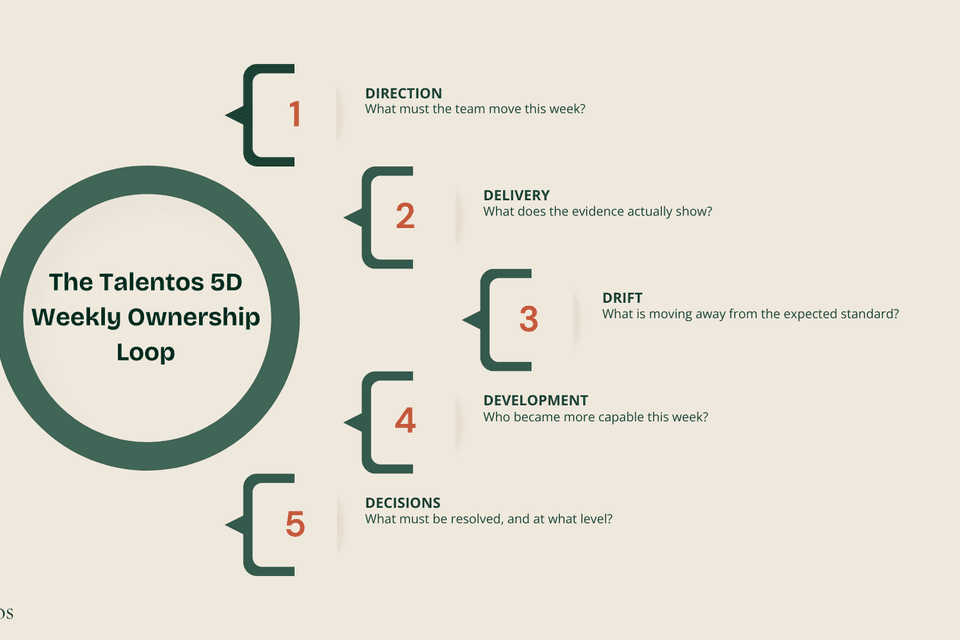
At Talentos, we organize the weekly work of management around five non-negotiable responsibilities. We call it The Talentos 5D Weekly Ownership Loop.
Why Weekly Ownership Matters
A month is long enough for a manageable problem to become an expensive crisis.
By the time a monthly report exposes a missed payment, a frustrated top performer, or an unresolved customer complaint, the opportunity to fix it cheaply has passed.
Weekly management creates a shorter distance between a risk and a decision. Without a weekly rhythm, a business accumulates "management debt." Unclear priorities remain unclear. Feedback remains unsaid. The work does not magically disappear; it just returns later with a higher price tag.
The Talentos 5D Weekly Ownership Loop

The five responsibilities below do not require five separate meetings. They are not a rigid Monday-to-Friday timetable. They represent the management work that must happen during the week, regardless of how your business is structured.
1. Direction: What must the team move this week?
If everything is a priority, nothing is. Your team might have twenty active tasks, but only a few outcomes will meaningfully shape the week. The manager’s first job is to convert competing demands into an executable week.
Direction is more demanding than just distributing tasks.
- A Task: "Follow up on overdue invoices." (This is an activity).
- Direction: "Reduce invoices overdue beyond 60 days by KSh 800k this week. Jane owns the disputed accounts. Escalate any account above KSh 300k where the customer rejects the paperwork."
A manager who names seven priorities has failed to prioritize. When everything is urgent, employees will just choose the easiest, most visible task. Direction requires the manager to make hard choices about what gets focus and what waits.
2. Delivery: What does the evidence show?
Direction creates commitments. Management must then follow up on them. Without review, a priority is merely an announcement.
A weak review sounds like this:
How is the customer follow-up going?" "We are working on it." "Okay, please make sure it gets done.
Nothing became clearer. A strong manager demands evidence. Was the invoice recovered? Is the customer approval signed? Is the milestone closed?
Every commitment must end the week in one of four states: Completed, Revised (with a valid reason), Blocked, or Canceled. It cannot remain in a fifth state called, "We are still following up." An unexplained delay is not a status; it is drift.
3. Drift: What is moving off track?
Not every problem begins as an explosion. Most begin as a slight deviation. A deadline slips by two days. Rework increases by 5%. One employee starts carrying an unfair share of the load.
These signals are easy to dismiss individually. Together, they show that performance is drifting.
When a team misses a target, weak managers immediately look for someone to blame. Strong managers diagnose the drift. Was the expectation clear? Was the handover broken at a Management Seam? Was the workload impossible? The manager’s job is to identify the drift and course-correct while recovery is still cheap.
4. Development: Who became more capable this week?
Some managers treat employee development as a luxury they will get to "when things quiet down." That quiet period never comes. Meanwhile, the manager continues rescuing the same errors.
Coaching is not just supplying the answer more slowly. If a manager immediately says, "Call the customer and offer delivery on Thursday," the employee remains dependent.
If the manager asks, "What options can we offer without creating another failure? What do you recommend?" the employee builds judgment. If your managers only teach their teams what to do, the team remains dependent. If they teach them how to think, the team builds capacity.
5. Decisions: What must be resolved, and at what level?
Teams bleed time when decisions remain vague. Problems bounce between departments, and meetings end with "let’s think about it."
Decision ownership means ensuring that important questions do not remain unresolved simply because deciding carries risk.
When a manager faces a problem that exceeds their authority, they should escalate it. But healthy escalation is not forwarding an email to the founder that says, "Please advise." As we outlined in Trained Waiting, a useful escalation explains the risk, outlines the options, and provides a clear recommendation. The founder should receive a decision request, not an unfinished investigation.
5 Habits That Destroy Weekly Ownership
If your managers are struggling to run the 5D Loop, they are likely trapped in one of these habits:
- Starting with tasks, not outcomes: A long task list creates motion, not progress. Start with the required result, then list the work.
- Only reviewing explosions: Managers who only focus on massive failures train their teams to hide small risks. Review the early signs of drift.
- Fixing the work, ignoring the worker: When a manager quietly rewrites an employee's bad report, the document is saved, but the manager just inherited that job forever. Correct the work, then address the performance.
- Meetings without commitments: A meeting is useless if it doesn't end with a decision, an owner, a deadline, and a review point.
- Escalating without recommendations: Esculating a problem should reduce uncertainty for the founder, not transfer all the thinking upward.
The Weekly Check
At the end of this week, ask your managers to answer these five questions:
- Direction: What were the team’s most important outcomes, and did everyone understand their part?
- Delivery: Which commitments were actually completed, revised, or blocked?
- Drift: What moved away from the expected standard, and how did you respond?
- Development: Whose capability or judgment became stronger?
- Decisions: What did you decide, and what did you escalate with a recommendation?
A manager who cannot answer these questions may have worked 60 hours this week. But hard work and management ownership are not interchangeable.
Management is visible when employees know what matters. It is visible when drift is corrected before it becomes a crisis. It is visible when people become more capable.
That is the work. Not the title. Not the meetings. Not the busyness. The work.
Ready to Build Real Accountability?
When managers mistake busyness for leadership, the founder remains the ultimate bottleneck. Talentos helps growing SMEs in Kenya define what managers should own, establish practical weekly rhythms, and create evidence that accountability is happening before problems reach your desk.