Your strongest technical employee has just solved another problem that nobody else could handle.
A valuable customer was threatening to leave. The records were a mess, the deadline had passed, and two other employees had already tried and failed to fix it. This employee stepped in, reconstructed the history, calmed the customer down, and stayed late to close the issue. By Monday morning, the account was safe.
The case for promotion appears obvious. They know the business. They are dependable. When something breaks, they are the person everyone trusts to fix it.
But before you give them a management title, you need to ask an uncomfortable question:
Have they demonstrated management capability—or have they just demonstrated how heavily the business depends on their personal output?
These are not the same thing.
A strong senior employee produces exceptional work and solves difficult problems. But a manager must do something entirely different: they must create the conditions for other people to produce reliable work.
Management is not a reward for tenure, age, or technical brilliance. It is a fundamental change in the unit of performance you are accountable for.
The Promotion Trap
Growing SMEs frequently promote their best employees for totally understandable reasons. The company desperately needs someone to supervise a department, so the strongest technical performer becomes the manager.
But the role usually only changes on the org chart.
The person continues handling the most difficult assignments, correcting their teammates' mistakes, and rescuing urgent work. The only difference is they now perform those exact same duties while also approving leave and attending management meetings.
Their title has changed. Their source of value has not.
The business may call them a manager, but it still relies entirely on what they can personally do. This creates a dangerous bottleneck: the new manager becomes exhausted, but the team does not become stronger. Employees continue escalating difficult work upward, and the manager has no time to coach them because they are still carrying the heaviest individual workload.
You haven't created management capacity. You’ve just overloaded your best employee.
The Core Distinction
The difference between these two roles can be summarized in one sentence:
A senior employee produces valuable work. A manager creates reliable performance through a team.
In a growing SME, managers are often "player-coaches." A Sales Manager will still handle a few strategic accounts; an Operations Manager will still step into complex projects. But a problem arises when their personal contribution remains the only convincing evidence that they are performing.
Technical work can remain part of a manager's job, but it cannot remain the entire job.
The Talentos Manager Ownership Test
How do you know if you have a real manager or just a senior employee with a fancy title? A true manager must produce evidence in four specific areas.
1. Team Result: Do they own what the team produces?
If a project misses a deadline, a senior employee might reasonably say: "My part was completed on time." A manager must ask: "Why did the team fail to produce the required result?"
A manager cannot separate their personal performance from the performance of the team they lead. If a manager can only report on activity (how many calls were made, how many tasks were completed) but cannot explain whether the team actually hit the business outcome, they are managing tasks, not results.
2. Work System: Do they organize how work moves?
Strong senior employees are incredibly valuable because they rescue recurring problems. When a handover fails, they personally track down the missing information and save the day. A manager must do more than solve the immediate problem. They must ask: "Where did the error begin, and what must change in our process so this doesn't break again tomorrow?"
The senior employee restores the work. The manager strengthens the system.
3. People Performance: Do they actively manage contribution?
Many people carry management titles while avoiding the most uncomfortable part of the job: addressing poor performance. They happily assign tasks, but when an employee repeatedly misses standards, they quietly absorb the extra work or wait for the founder to intervene.
A manager does not need to be aggressive, but they must make performance discussable. They must set expectations, give immediate feedback, and follow up on improvement. If a manager’s only response to a weak employee is to complain to the founder, they are supervising, not managing.
4. Team Capability: Does the team get stronger under them?
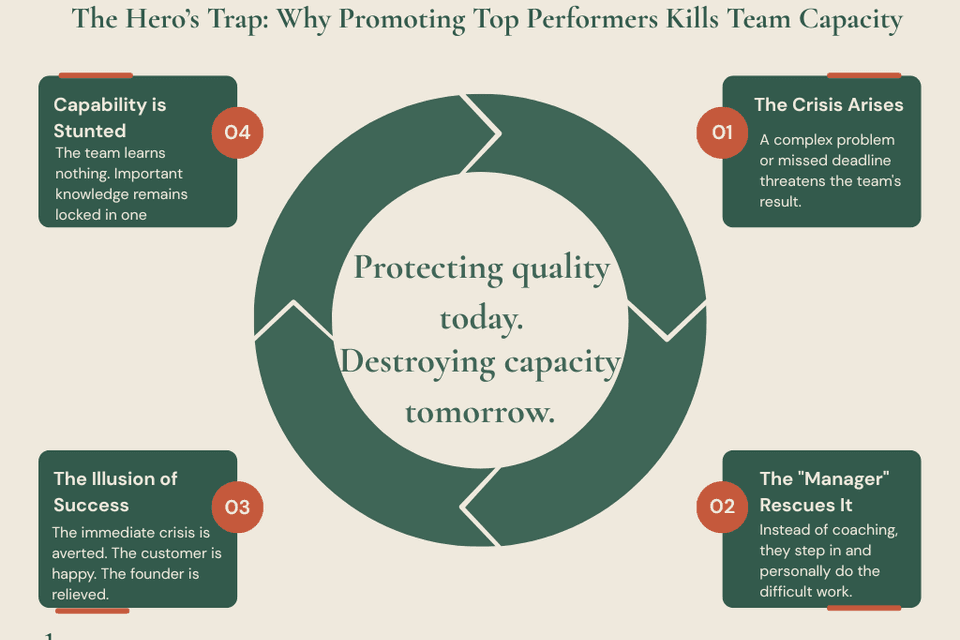
This is the test businesses overlook the most. A manager might hit their targets this month by personally executing all the hardest work. The customer is happy, but what has changed inside the team? Can anyone else handle that problem next time? Or is the team totally dependent on the manager's personal expertise?
A manager who remains indispensable to every difficult task is protecting quality today at the expense of capacity tomorrow.
The Case Study: The Manager Who Rescues Everything
Consider a Customer Service Manager named Miriam.
Miriam understands your customers better than anyone else. Whenever a complaint escalates, the team hands it to her. She reconstructs the history, coordinates with operations, and calms the client down. From one perspective, Miriam is an excellent manager. She protects revenue.
But look at her team twelve months later.
Her staff still struggles to investigate complaints independently. Important customer knowledge is entirely locked inside Miriam's head. When Miriam takes a week of leave, the department paralyzes.
Miriam is producing exceptional personal work, but her team is stagnant. Apply the test:
- Work System: Has she created a clear escalation process, or is she the entire process?
- Team Capability: Can anyone else handle these complaints now, or did she just do it for them?
Miriam hasn't failed. But the business has failed Miriam. They promoted her, but continued to reward the exact behaviors that made her a senior employee: personal rescue and individual reliability.
Before You Judge the Person, Examine the Role
If someone is failing the Manager Ownership Test, do not immediately assume they are incapable. Often, the business has not designed a workable management role. Ask yourself:
- Did you reduce their technical workload? You cannot expect someone to manage a team if they are still carrying 100% of their old technical tasks.
- Do they have real authority? A manager cannot own results if they have to ask your permission for every minor decision.
- What are you rewarding? If bonuses and praise are still tied exclusively to their personal sales or output, they will protect the work that pays them. You get what you reward.
Final Thought
A senior employee can be one of the most valuable assets in your company. They hold deep knowledge, protect standards, and solve complex problems.
Do not force them into management just because it is the only way to give them a pay raise. Management is not a promotion above technical work; it is an entirely different profession.
The next time you look at your org chart, pick a manager and ask the ultimate question: If this person stopped doing the team’s most difficult work personally, what evidence of management would remain?
The answer will tell you exactly what kind of business you are building.
Is Your Management Team Actually Managing?
When managers act like senior employees, the founder remains the ultimate bottleneck. Talentos helps founder-led SMEs in Kenya clarify management roles, define decision rights, and build the rhythms required to make ownership real.
Stop promoting people into titles without giving them the tools to lead. Start by identifying the structural gaps in your team.