You have delivered the speech. You sat your leadership team down and told them to take ownership, make decisions, and stop bringing every operational hiccup to your desk.
Even if you have recently repaired your Management Seams and properly aligned your departments, the interruptions haven't stopped.
The "got a minute?" drop-ins still derail your afternoons. Your WhatsApp still lights up with operational questions at 8:00 PM.
A key supplier delays a critical shipment. Your Operations Manager walks into your office, perfectly outlines the risks, explains the impact on the client, and then does the one thing that drives you crazy:
She pauses. And waits for you to tell her what to do.
Because the matter is urgent, you answer. You know the business better than anyone, and it is faster to just give the solution than to guide her through your reasoning. The crisis is averted.
But something else just happened in that room. Your manager learned that bringing the final decision to you is faster, safer, and more reliable than making it independently.
From your perspective, the problem is obvious: “My team lacks initiative.” From your manager’s perspective, the lesson is equally obvious: “Important decisions still belong to the founder.”
This is how waiting becomes your company's default operating system. Not because you explicitly asked them to wait, and not because your managers are incompetent. They wait because your daily, repeated reactions have taught them that waiting is the safest survival strategy.
The Two Sets of Rules in Your Business

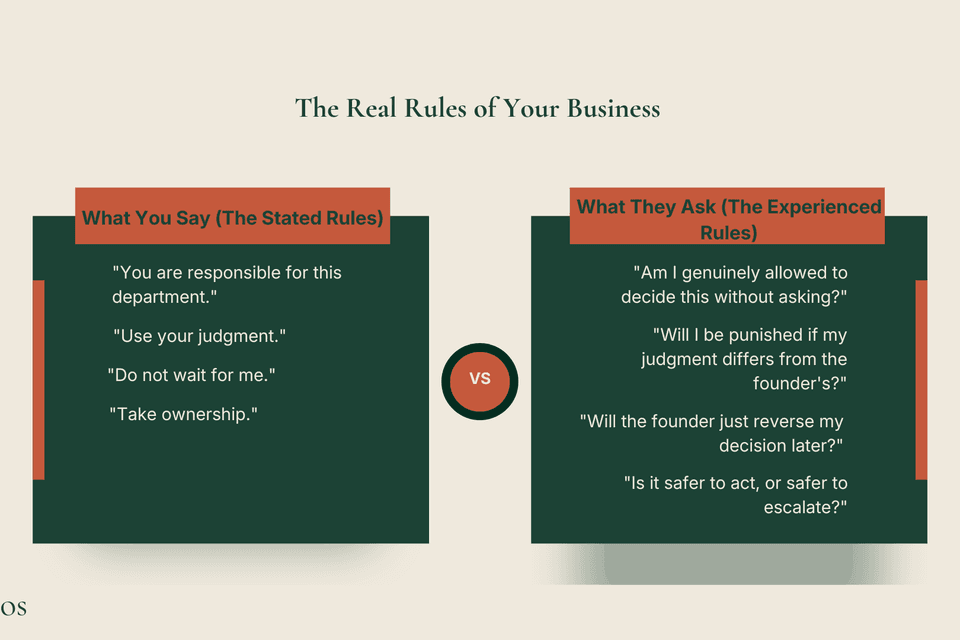
Every company operates on two sets of rules. The stated rules, and the experienced rules.
The Stated Rule: "You are fully responsible for this department." The Experienced Rule: "I am responsible for the work, but if I don't consult the founder before a major decision, I will be criticized for overstepping."
The Stated Rule: "Bring me solutions, not just problems." The Experienced Rule: "If my solution is even slightly different from how the founder would do it, they will just override me anyway. It’s easier to just ask them first."
The stated rules matter, but the experienced rules dictate behavior. You may genuinely want your managers to act like owners, but when you answer too quickly, correct too aggressively, or take work back when it isn't perfect, you create an environment that penalizes independent thought.
The Talentos Decision Confidence Test
Before pulling the trigger on a decision, your managers unconsciously run through three checks. If even one is missing, they will default to waiting.
1. Authority: "Am I genuinely allowed to decide this?"
You might give someone a title without giving them the pen. If your Head of Customer Service cannot approve a 5,000 KES client concession without your signature, you haven't delegated authority. You’ve just delegated the administrative task of asking you for permission.
2. Stability: "Will my decision stand?"
Imagine your manager makes a reasonable call. It isn't exactly how you would have handled it, but it works. If you step in and change it simply because you prefer your own method, the manager learns a hard lesson: they aren't being asked to exercise judgment. They are being asked to read your mind. Escalating the problem to you becomes more efficient than deciding twice.
3. Safety: "What happens if the outcome isn't perfect?"
Business guarantees nothing. A customer may reject a fair proposal; a marketing campaign might flop despite good data. If every imperfect outcome results in you stripping authority away and taking over, your team learns they are only safe when outcomes are 100% guaranteed. Because nothing is guaranteed, they do nothing.
6 Ways You Are Accidentally Teaching Them to Wait
Trained waiting isn't created by one dramatic blowup. It is built through small, daily interactions. Here is how you are actively training your team to stop thinking:
- Answering Before They Think: When a manager brings you a problem and you immediately solve it, you become the business’s most convenient search engine. They aren't practicing leadership; they are practicing escalation.
- Delegating the Task, Keeping the Decision: You hand over a project but refuse to let the manager choose the supplier or approve basic expenses. They own the project in name, but you kept the steering wheel.
- Punishing "Different" as "Wrong": A manager makes a call that differs from your preferred approach. If you intervene, you send the message that their judgment is only valid when it perfectly clones yours.
- Rescuing Imperfect Work: They move slower than you. Their first draft is rough. You panic, take the laptop, and finish it yourself. You just taught them that if they struggle long enough, you will eventually do their job for them.
- Punishing Action More Heavily Than Delay: A manager makes a bold decision and it fails. You react strongly. Another manager avoids making a decision for four days, slowing down the whole company. You step in and quietly fix it. You just taught the company that visible mistakes are fatal, but invisible delay is tolerated.
- Bypassing Them in an Emergency: When a deadline looms, you bypass the manager and go straight to their direct reports with instructions. The team learns you are the real manager, and the manager learns their authority is an illusion.
Healthy Escalation vs. Trained Waiting
The goal is not to stop managers from bringing you anything. That leads to arrogance and reckless financial risk. Strong managers know exactly when to decide and when to escalate.
You can hear the difference in how they stand in your doorway.
Healthy escalation sounds like: "This exceeds my approved budget limit. Here are the risks, and here is my recommendation. Do I have a green light?" Trained waiting sounds like: "I didn't want to make the wrong call here. Tell me what you want me to do."
Healthy escalation is triggered by risk. Trained waiting is triggered by self-protection.
How to Break the Pattern
You cannot reverse trained waiting with one motivational speech. You have to rewire their daily experience. Starting tomorrow, force these three habits:
- Return the Decision: When they bring an issue that sits within their authority, do not give them the answer. Say: "This decision sits with you. Talk me through what you recommend."
- Coach the Reasoning: When their recommendation is weak, do not immediately replace it with your own. Ask: "What options did you reject? What is the downside of waiting?" Your experience should be used to strengthen their judgment, not just supply the answer.
- Review the Outcome, Don't Revoke the Authority: When a decision produces a poor result, review the process. Was the available information used properly? Were risks considered? Make accountability a tool for development, not a weapon for punishment.
Stop Managing the Symptoms
Founders keep intervening because they fear losing control. But constantly acting as the company's safety net is the weakest form of control. True control comes from clear decision rights, visible outcomes, early escalation thresholds, and reviewable reasoning.
The most important question is no longer, “Why do my managers keep asking me what to do?”
It is: “What have my reactions taught them to do?”
Conduct a Performance Clarity Check
When your team cannot act without your involvement, another speech about "taking ownership" won't fix it. Talentos helps founder-led businesses in Kenya clarify decision rights, strengthen management capability, and create visibility without pulling every operational decision back to the founder.
Our Performance Clarity Check identifies exactly where accountability is breaking down in your daily operations.