Your Operations Manager has a job description. It is three pages long. It says they are responsible for coordinating suppliers, supervising staff, preparing reports, monitoring stock, and handling operational issues.
Six months later, you are deeply frustrated.
Suppliers still surprise you. Stock problems only reach you when they have already become emergencies. Reports arrive on time, but you still have to ask three follow-up questions just to understand what is happening.
So you sit down with the manager, and they say the one thing that makes the conversation impossible:
"But I am doing everything in my job description."
You look at the document. Technically, they are right. They attend the meetings. They prepare the reports. They communicate with suppliers. They respond when problems arise.
So why is the role failing?
Because you described the work, but you never defined the value that work was supposed to create. That is the difference between a job description and a role scorecard. And confusing the two is the primary reason performance conversations in growing SMEs become bitter, subjective, and useless.
The Trap of "Performance by Interpretation"
A job description is necessary, but it is fundamentally insufficient. It tells an employee what sits within their area of responsibility, but it does not answer the only question that matters to a founder: Is this person actually succeeding?
When you rely on a job description to measure performance, you create a dangerous gap. The responsibility tells the employee where to spend their time. It does not tell them what good performance looks like.
That gap is instantly filled by interpretation. The employee evaluates their performance based on checking off tasks. The founder evaluates their performance against a set of business outcomes that were never written down.
The Job Description (What the Employee Reads)
"Coordinate suppliers."
The Unwritten Scorecard (What the Founder Expects)
"I should no longer have to chase suppliers myself."
The Job Description (What the Employee Reads)
"Prepare weekly operational reports."
The Unwritten Scorecard (What the Founder Expects)
"I should be able to see problems early enough to act."
The Job Description (What the Employee Reads)
"Supervise the operations team."
The Unwritten Scorecard (What the Founder Expects)
"Routine staff issues should stop landing on my desk."
The Job Description (What the Employee Reads)
"Resolve operational issues."
The Unwritten Scorecard (What the Founder Expects)
"The exact same problem should not happen every single week."
Both sides walk into the performance review with completely different versions of reality. The employee says, "I completed the work." The founder replies, "But the work didn't produce what I expected."
Because there is no shared reference point, the feedback immediately becomes personal and lazy: "You need to be more proactive," or "You need to take more ownership."
You cannot hold someone accountable for a standard that only exists in your head.
The 90-Day Absence Test
You are not paying for a collection of activities. You are paying because a role should create or protect something valuable in the business.
You do not hire an Operations Manager because somebody needs to attend operational meetings; you hire one because execution needs to become reliable. You do not hire a Credit Controller to send emails; you hire one to control cash collection.
If you are struggling to define the value of a role, run The 90-Day Absence Test.
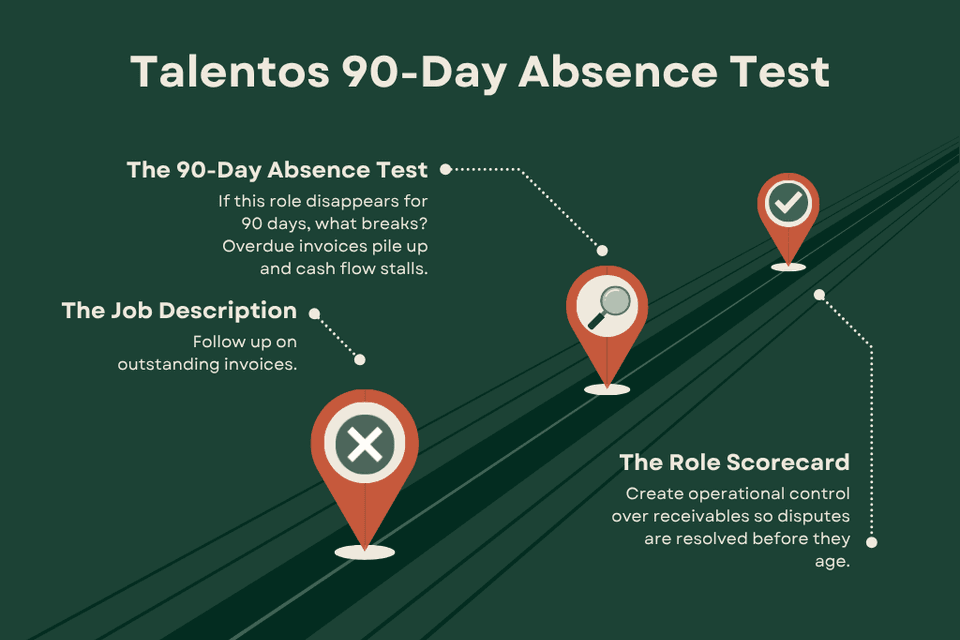
Imagine the role disappears tomorrow. Nobody replaces the employee. The business continues for 90 days. What starts to break?
Take an Accounts Receivable role. Without it:
- Overdue invoices increase.
- Disputes remain unresolved and stall cash flow.
- Management loses visibility over risky accounts.
- The founder is pulled back into chasing payments.
Now, reverse those failures. You have just identified the actual value of the role:
- Receivables are followed up consistently.
- Payment disputes are resolved before they age.
- Management has reliable visibility over collection risk.
Notice the shift. We moved from an activity ("Follow up outstanding invoices") to a business outcome ("Create operational control over receivables").
The Talentos Role Scorecard
A role scorecard is not a job description with a few KPIs stapled to the bottom. It is an operational contract. At its simplest, it answers three non-negotiable questions.
1. Why does this role exist?
Not the title. Not the duties. The business purpose.
Operations Manager Purpose: To make routine operations reliable enough that customer commitments are met, risks are identified early, and the founder does not need to personally coordinate daily execution.
2. What outcomes must the role reliably create?
These are the conditions that prove the role is working.
- Delivery Reliability: Customer commitments are executed consistently, and foreseeable delays are flagged early.
- Operational Control: Stock, supplier, and workflow risks are visible before they become emergencies.
- Problem Resolution: Recurring operational failures are structurally corrected, not repeatedly rescued.
3. What evidence proves those outcomes are happening?
This is where measurement begins. But be careful: a scorecard is not just a KPI sheet.
If a job description says "Prepare weekly reports," and the KPI is "100% of reports submitted by Friday," the employee can hit a green KPI every week while submitting a completely useless report that hides all the department's risks. You have successfully measured an activity without establishing if it creates value.
Define the outcome first, then demand the evidence.
The Defense Against Role Drift
A role scorecard is not just a tool to hold employees accountable; it holds the business accountable for its own expectations.
In growing SMEs, roles mutate. You hire someone to manage administration. Three months later, they are coordinating procurement, handling HR complaints, and managing office operations. When they inevitably drop a ball, the founder gets frustrated that they aren't "taking ownership."
But ownership of what? The role changed. The founder’s expectations changed. But the document defining success did not.
This is Role Drift. A scorecard forces the business to periodically stop and ask: Is this still the role we hired them for? Are we evaluating them against expectations we never formally reset?
The Operational Sequence
This is not a debate about which document is better. You need both, but you must use them in the correct sequence.
- The Job Description establishes the Work (Scope and duties).
- The Role Scorecard establishes the Outcome (The value created).
- The Measures establish the Evidence (Metrics and standards).
- The Performance Review establishes the Assessment (Did the work produce the outcome?).
If you skip the scorecard, you jump directly from a list of duties to a list of KPIs. That is how businesses end up with metrics that are easy to count but have absolutely no connection to whether the company is actually succeeding.
Get Performance Out of Your Head
A growing business eventually reaches a stage where the founder can no longer be the organization’s unofficial, walking definition of "good performance."
Your employees cannot continually depend on you to look at their work and tell them if it "feels right." You cannot manage a team if every role carries a different set of unwritten, invisible expectations.
A job description tells someone what they do all day. A role scorecard tells them what must be true in the business because they did it well. Define the outcome, write it down, and stop managing by interpretation.
Talentos helps founder-led SMEs build practical performance systems that make expectations, accountability and evidence clearer across the business. If your team has job descriptions but performance still feels subjective, the problem may not be the document you have. It may be the performance layer that is missing.