The Sales Manager has good news: Revenue target achieved.
The Operations Manager has good news too: On-time dispatch target achieved.
Procurement reduced purchasing costs.
Customer Service improved response times.
Finance increased the number of overdue accounts followed up each week.
Every manager walks into the monthly review with green numbers on their scorecard. And yet, you have a problem.
Margins are getting thinner. Customers are complaining about fulfillment. Cash is tighter than expected. Your managers are blaming one another. The business somehow feels harder to run than it did three months ago.
So the obvious question is: How can everyone be hitting their KPIs while the business itself is getting worse?
Because a KPI does not automatically become useful simply because it can be measured. Sometimes the employee has not failed the KPI. The KPI has failed the business.
A KPI Does More Than Measure Performance
Most conversations about KPIs begin with measurement: What should we track? How often? What is the target?
Those are useful questions, but they come too late. Before you assign a KPI, you need to understand one unbending rule of management: The moment you hold someone accountable for a number, you start influencing how they work.
People pay attention to what the business measures. They prioritize it, defend it, and make trade-offs around it. That means every KPI is doing two jobs at once: it is measuring behavior, and it is shaping behavior.
A badly designed KPI produces a dangerous result: A good employee becomes extremely efficient at achieving the wrong thing.
Consider the Sales Manager who is given one clear KPI: Achieve KSh 12 million in monthly sales.
By the end of the month, they hit KSh 12.7 million. Target exceeded. The scorecard is green. But then Finance looks more closely:
- Sales were made on generous credit terms to customers with outstanding balances.
- Orders were heavily discounted to close before month-end.
- Operations paid overtime to meet delivery promises Sales made without checking capacity.
- Procurement bought urgent, expensive materials to fulfill the orders.
Revenue went up, but margin, cash, operational stability, and the customer experience were crushed.
Was the Sales Manager wrong to chase the target? No. They did exactly what the business told them mattered. The KPI taught the employee to optimize revenue. But the business actually wanted profitable, collectible, deliverable revenue. Those are not the same thing.
Every KPI is a Business Hypothesis
When you assign a KPI, you are making an assumption. You are saying: "If this person improves this number, we believe something important in the business will improve as a result."
Underneath every KPI sits a business hypothesis. And hypotheses can be wrong.
If an employee achieves their KPI but the business result does not move, it does not automatically prove the employee failed. It proves that management chose the wrong lever. This is why KPIs should not be permanent commandments carved into stone. They are tools to help the business learn what actually drives performance.
The KPI Distance Problem
Individual performance measures usually go wrong in one of two directions: they are either too far from the employee, or too close.
Too Far (The Economic Outcome):
You tell an Operations Officer to "Increase company revenue by 20%." This matters to the company, but the employee doesn't control pricing, market demand, or the sales team. The KPI is economically important but operationally unfair.
Too Close (The Activity):
You tell Customer Service to "Close 90% of complaints within 24 hours." It is highly controllable. But people begin closing tickets to protect the metric, even when the customer's problem isn't actually resolved.
The most useful KPI sits between these two extremes. It measures something the employee can materially influence, with a credible connection to the final result. We call this a Controllable Value Driver.
The chain looks like this:
Business Result → Value Driver → Role Lever → KPI
Every KPI Needs a Guardrail
Before approving a KPI, you must ask one uncomfortable question:
How could a capable employee hit this number while making the business worse?
If Procurement's KPI is to reduce purchasing costs by 8%, they could hit it by buying cheaper materials from unreliable suppliers. The KPI is green; the business is worse.
A primary KPI needs a guardrail to protect the company from an employee succeeding too literally.

The "Game My KPI" Test
Before a KPI goes live, sit with the employee and ask: "If you wanted to hit this target without actually producing the business result we want, how would you do it?"
Give them permission to attack the measure. That conversation is not cynical; it is quality control. You are testing the measurement system before your employees are forced to work inside it.
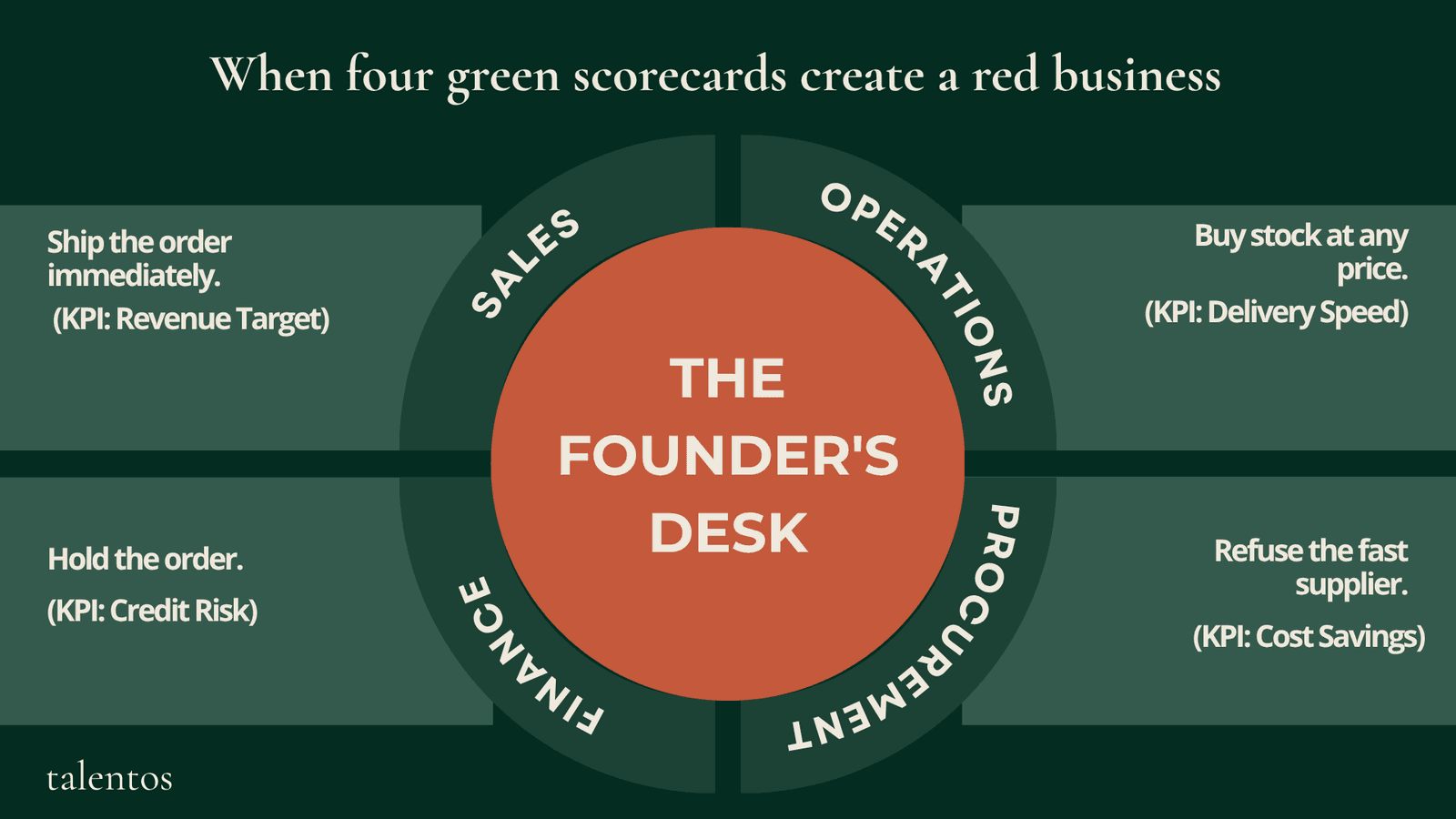
KPI Collision: When Green Scorecards Make Red Businesses
A KPI can make perfect sense inside one department and still damage the wider business.
Imagine Sales wins a large, urgent order.
- Sales says: Ship it (to protect the revenue target).
- Operations says: Buy stock immediately (to protect delivery speed).
- Procurement says: We can't use the fast supplier (to protect the cost-savings target).
- Finance says: Hold the order (because the customer has an overdue balance).
Everybody is doing their job. Everybody has a rational incentive. And everybody wants a different decision.
Who settles it? Usually, the founder.
If every cross-functional decision requires the founder to step in and decide which manager's target matters most, your KPIs are not creating alignment. They are outsourcing unresolved strategy to the founder. You have built four individually rational incentives that create one collectively irrational company.
The 5 KPI Tests
Before you put a number on somebody's scorecard, put it through the Talentos 5 Tests:
- The Value Test: If this number improves, why should the business actually care?
- The Control Test: Does this employee have the authority, resources, and decision-making ability to materially influence it?
- The Timing Test: Will this measure tell us something early enough to act, or only confirm failure after it happens?
- The Gaming Test: How could someone hit this KPI while missing the real objective? (If the answer is easy, build a guardrail).
- The Collision Test: What other behavior or department could this KPI accidentally damage?
If a KPI cannot survive those five questions, do not solve the problem by writing a more aggressive target next to it. Fix the measure.
Measure the Thing You Actually Want
A KPI is never the business itself. It is a proxy.
Do not let the proxy quietly become the objective. Because when you tell people, "This is the number that matters," they will listen. They will reorganize their work around it. They will change how they negotiate. They may even stop doing valuable work that is invisible to the scorecard simply because the visible number is what gets discussed every month.
Before you ask whether an employee achieved their KPI, ask an even more important question: If they achieve this KPI exactly as we designed it, will we actually like the business it creates?
If the answer is uncertain, the target is not finished.