Open a typical performance appraisal form in a growing SME. You will probably find some version of the following:
- Performance rating (1 to 5)
- Achievements
- Areas for improvement
- Salary recommendation
- Promotion potential
- Objectives for next year
The employee and manager are given sixty minutes. Inside that single hour, the business expects them to answer several wildly different questions: How well did this person perform? Should they cost the company more money next year? Are they ready for a promotion? What weaknesses must they fix? Is their performance bad enough to require formal disciplinary action?
Then leadership wonders why the conversation becomes awkward, the employee gets defensive, and the paperwork is full of vague corporate speak.
The problem is not that the appraisal is annual. The problem is that the appraisal is structurally overloaded. It has become a dumping ground for decisions that should never be made in the same way, using the same evidence, at the same time.
The Trap of Bundled Decisions
Consider what happens when an employee walks into a review knowing their salary increase depends entirely on the next hour.
The manager asks: "What do you think you need to improve?"
How honestly is the employee going to answer? If they admit they struggle with commercial negotiation, does that demonstrate self-awareness, or have they just handed the manager a justification to reduce their pay?
The employee protects their paycheck. They minimise mistakes. The manager does the same to avoid an argument. A conversation that was supposed to produce operational learning immediately becomes a negotiation over financial consequences.
When a business expects one conversation to yield several different employment decisions even though those decisions require different evidence, timing, and levels of formality the process collapses.
Imagine trying to use one financial meeting to audit last year's accounts, set executive bonuses, investigate missing inventory, and redesign the company's strategy. Nobody would call that good governance. Yet businesses routinely do the equivalent with their payroll.
Decision Contamination and the 4/5 Rating
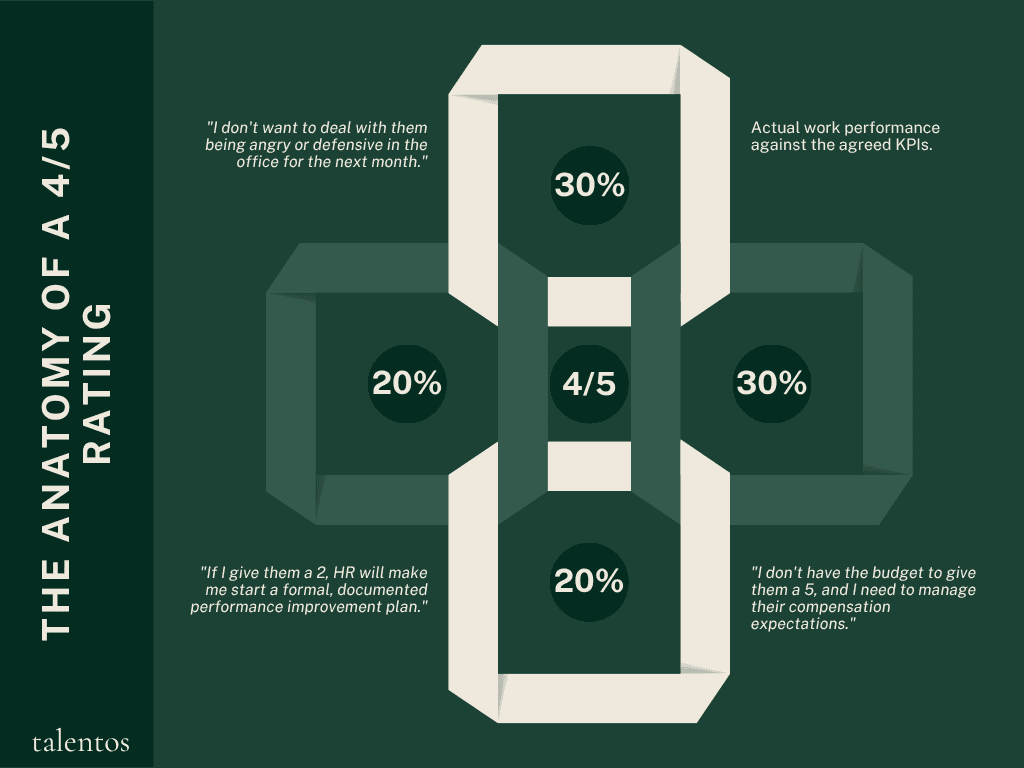
To simplify this complexity, companies introduce a performance rating. That rating quietly becomes a universal currency. A "4 out of 5" is supposed to mean a good performer, a higher bonus, and promotion potential.
But look at what that rating actually captures. Managers quickly stop evaluating performance and start managing consequences.
- "She is performing well, but if I give her a 4, she will expect a promotion we don't have." (So they rate her a 3).
- "I don't have the budget for the increase that comes with a 5." (So they rate him a 4).
- "If I give him a 2, HR will make me start a formal, documented disciplinary process." (So they rate him a 3 and write "needs to improve consistency").
The manager’s judgment about actual work is distorted by the consequences attached to the rating. The number stops being a measurement of performance and becomes a negotiated compromise designed to balance the budget, avoid HR paperwork, and prevent an awkward confrontation.
This is decision contamination. The business thinks it has data on employee capability, but it only has data on manager conflict-avoidance.
Flattening the Timeline
A year is a long time. It contains twelve months of projects, mistakes, changing priorities, and shifting business conditions. Compressing all of it into one meeting and one score flattens the reality of how the business actually operated.
Imagine two employees. Employee A was weak from January to March, improved in Q2, and was consistently strong from July to December. Employee B was excellent from January to June, inconsistent in Q3, and deteriorated rapidly in Q4.
On an annual appraisal form, they might end up with the exact same average score. But they present completely different management problems. Employee A developed; Employee B is failing. A single annual score flattens the direction of performance. It gives management the destination, but it hides the trajectory—and the trajectory is what dictates your next operational move.
The Fix: How to Actually Sequence a Performance Review
You cannot fix an overloaded meeting by adding more sections to the HR form. You fix it by separating the decisions into a disciplined sequence.
Nothing materially important about an employee's performance should be discovered for the first time in an annual appraisal. The formal review is not a performance discovery meeting. It is a performance decision meeting.
Here is exactly how a leadership team should restructure the review process so the business gets the truth, and the employee gets clarity.
Step 1: The Performance Audit (What happened and what does it mean?)
Who: Manager and Employee The Focus: The past. This is a dedicated conversation strictly about the historical record. Before salary, before future goals, and before career ambitions.
- What outcomes were expected?
- What evidence exists?
- Did the employee meet the agreed standard?
Crucially, compensation and promotion have not entered the room yet. The judgment must stand on its own. If the employee performed exceptionally, that is a fact—even if the company cannot afford a pay raise. Lock in the performance truth before you discuss the consequences.
Step 2: The Consequence Calibration (What follows?)
Who: Management and Leadership (Behind closed doors) The Focus: The business constraints. Once the performance audits are complete, management decides what follows. This is where compensation, bonuses, and role changes are determined based on the performance evidence, market positioning, and company budget.
By separating this from the employee meeting, management can make objective financial decisions without managers artificially lowering performance scores just to fit a tight budget.
Step 3: The Future Reset (What must change?)
Who: Manager and Employee The Focus: The future. Now the manager and employee meet again. The manager communicates the compensation decision as a separate fact. Then, the conversation pivots entirely to the future. The employee is no longer wondering if admitting a weakness will cost them money, the money is already decided. Now they can honestly discuss capability gaps, stretch work, and new KPIs for the upcoming year. The future gets its own dedicated focus, rather than being an afterthought at the end of a stressful evaluation.
Stop Asking One Meeting to Do Everything
This does not mean you need to drown your company in endless meetings. Steps 1 and 3 can happen a week apart.
But you must separate the evidence from the financial consequence.
A useful, mature performance system allows a founder to say things that appear contradictory but are actually perfectly coherent:
- "You performed exceptionally well this year, but we do not currently have the budget for a maximum salary increase."
- "Your salary will increase to match market rates, but there is a critical commercial capability you must build before we consider you for a promotion."
Those statements are impossible when every organisational decision is compressed into one compromised, contaminated rating.
If your appraisals feel like a bureaucratic waste of time, do not switch from annual to quarterly reviews that just forces your team to endure a badly designed meeting four times a year. Decide exactly which questions belong together, and permanently separate the ones that don't.