How to Turn Business Goals Into Employee Performance Expectations
In our previous article, Your Business Has Growth Targets. Does Your Team Know What to Do With Them?, we explored a common problem in growing businesses.
The founder has a clear target. Increase revenue. Improve cash flow. Retain more customers. The target may be discussed during a management meeting and then shared with employees. Everyone agrees that it is important.
But a few weeks later, little has changed. Salespeople are still following up with customers in the same way. Invoices are still being delayed. Customer complaints are still being handled differently by each person. Managers are still waiting until the end of the month to discover that a target is off track.
The problem is not always that employees do not care. The business goal may simply not have been translated into clear employee performance expectations. A business goal tells the company what it wants to achieve. A performance expectation tells a particular employee what they are responsible for contributing, what good performance looks like and how progress will be reviewed. That translation is the focus of this article.
Business goals do not automatically create employee action
Consider a founder who tells the team:
"We need to increase revenue by 20% this year."
This may be a clear business target, but it does not tell employees what to do differently.
- The salesperson may think the answer is to make more calls.
- The account manager may think the answer is to keep existing customers happy.
- The finance employee may think revenue is not their responsibility.
- The operations manager may continue focusing only on delivery.
Meanwhile, the founder may expect all four people to contribute to the target. Nobody is necessarily wrong. They are simply working from different interpretations of the same goal. This is where many growing businesses lose alignment. A goal that is clear in the founder's mind can still be unclear at employee level.
Research supports the importance of closing this gap. Gallup's work on clear expectations describes knowing what is expected at work as a basic employee need. It also explains that a job description alone is not enough. Managers must discuss what good performance looks like and how an employee's work contributes to the wider business. The solution is not to give every employee the company target. The solution is to show each person how their role contributes to it.
A business goal is not the same as a performance expectation
A business goal describes the result the organisation wants. Examples include:
- Increase monthly revenue.
- Improve customer retention.
- Reduce project delays.
- Improve cash collection.
- Reduce stock losses.
- Protect profit margins.
An employee performance expectation describes the contribution expected from a particular role. For example:
Follow up all approved quotations within two working days, record the customer's response and raise stalled opportunities during the weekly sales meeting.
That expectation is clearer because the employee can answer five important questions:
- What am I expected to do?
- What result should my work support?
- What standard should I meet?
- What evidence will show what happened?
- When will my manager review it?
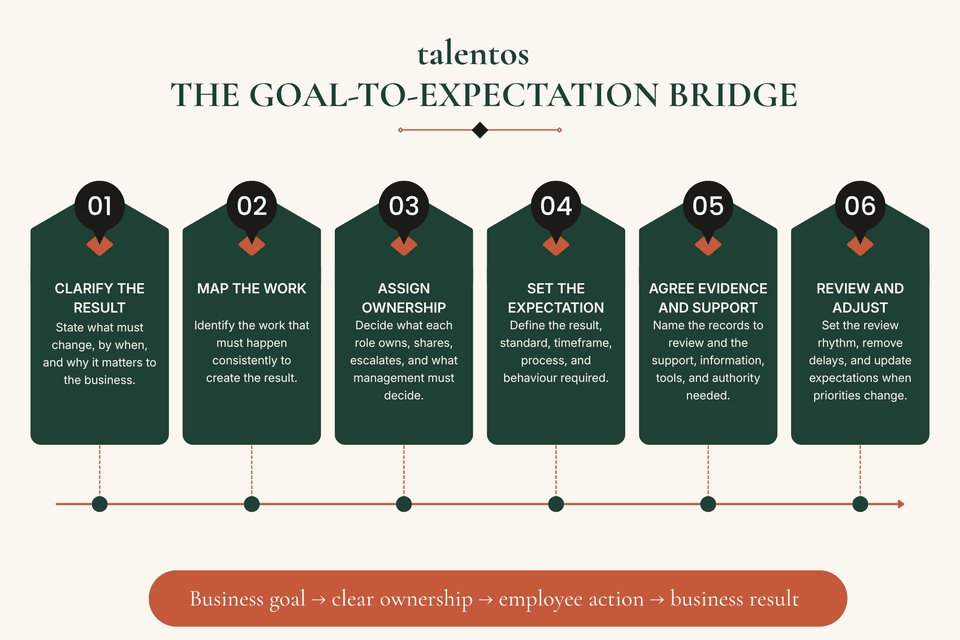
At Talentos, we bring these parts together using the Talentos Goal-to-Expectation Bridge.
The Talentos Goal-to-Expectation Bridge

The Goal-to-Expectation Bridge helps managers move from a broad company target to clear expectations for teams and individual employees. It follows six steps:
1. Start with the business result
Begin by stating what the business is trying to achieve.
Avoid broad statements such as:
“We need to grow.”
“We need to improve customer service.”
“We need to become more efficient.”
These statements show direction, but they are too wide to guide employee performance. A clearer business goal could be:
Increase monthly sales from KSh 8 million to KSh 10 million over the next six months while maintaining the agreed profit margin.
Or:
Reduce the value of invoices that remain unpaid for more than 60 days.
Or:
Reduce project losses caused by rework and customer changes that were not approved.
A clear business result should answer three questions:
- What needs to change?
- By when?
- Why does it matter to the business?
For example:
Reduce invoices unpaid for more than 60 days over the next three months so that the business can improve cash flow and meet supplier commitments more reliably.
This is much clearer than simply saying:
“Finance needs to improve collections.”
The business result should tell the leadership team what matters. At this point, however, it is still a company goal. It is not yet an employee performance expectation.
2. Identify the work that creates the result
The next question is:
What work must happen consistently for this result to be achieved?
For example, increasing revenue may require:
- More qualified sales opportunities
- Faster responses to customer enquiries
- Timely preparation of quotations
- Consistent customer follow-up
- Reliable stock availability
This step matters because business results rarely come from one activity or one department. Revenue is not created only by the sales team. A salesperson may secure an order, but the business will still struggle if:
- The quotation takes too long to prepare
- The product is out of stock
- The order is prepared incorrectly
- Delivery is delayed
- The customer receives poor service
The same applies to cash flow. Cash flow is not improved only by asking the finance team to send more payment reminders. It may also require:
- Project teams submitting completion documents promptly
- Account managers resolving customer disputes
- Salespeople agreeing clear payment terms
- Finance issuing correct invoices
- Directors approving credit notes and discounts
Before giving an employee a target, identify the work that actually creates the business result. This prevents the company from placing responsibility on one employee for a result that depends on several people.
3. Assign clear ownership
Once the required work is clear, decide which teams and roles contribute to it.
The question is:
Who owns each part of the work?
In a distribution business, a revenue goal may involve:
- Sales: Finding customers, following up quotations and closing orders
- Procurement: Maintaining the right products and stock levels
- Stores: Preparing complete and accurate orders
- Managers: Reviewing progress and removing internal delays
In a smaller company, one employee may perform several of these roles. That is not a problem. The important thing is to make the ownership clear. For each role, the manager should identify:
- What the employee owns directly
- What the employee shares with others
- What the employee must escalate
- What management must decide
- What result the role is expected to support
For example, a finance officer may own the preparation of accurate invoices. However, the finance officer may depend on:
- A project manager submitting completion documents
- An account manager confirming customer acceptance
- A director approving a discount
- A customer providing purchase-order details
The finance officer should not be given full responsibility for invoicing delays without recognising these dependencies. The expectation might therefore state:
Prepare and issue complete invoices within one working day of receiving the required documents. Raise missing information during the weekly collections meeting.
The finance officer owns prompt invoicing and escalation. The project manager owns the submission of documents. The director owns decisions requiring senior approval. This is clearer and fairer than telling the finance officer:
“Make sure we get paid faster.”
Do not assume employees will work out these connections themselves simply because the company is small. Clear ownership prevents important work from falling between roles.
4. Write the performance expectation
Once ownership is clear, define what the employee is expected to deliver. Managers often mistake a list of duties for a performance expectation. Consider these statements:
Update the sales spreadsheet.
Call customers.
Prepare invoices.
These are activities. They describe work that should be done, but they do not explain the result the work should create or the standard the employee should meet. A stronger expectation connects the activity to its purpose.
Instead of:
Update the sales spreadsheet
Use:
Maintain an accurate record of active sales opportunities so that the manager can identify delayed follow ups and sales risks during the weekly review.
Instead of:
Prepare invoices
Use:
Issue complete and accurate invoices within one working day of receiving the required supporting documents.
The employee should understand not only what to do, but what the work is expected to achieve. The expectation should also explain what good performance looks like. A useful performance standard may cover:
- Quantity: How much work is expected?
- Quality: How well should it be completed?
- Time: How quickly or by when?
- Cost: What spending or resource limits apply?
- Process: What steps must be followed?
- Behaviour: How should customers and colleagues be treated?
Guidance on setting clear performance expectations similarly recommends describing standards through areas such as quantity, quality, time, cost and manner of performance. For example:
Unclear expectation
Follow up quotations quickly.
Clearer expectation
Follow up every approved quotation within two working days, record the customer’s response and agree on the next action.
Another example:
Unclear expectation
Improve customer service.
Clearer expectation
Acknowledge priority customer complaints within one working hour, confirm who is handling the issue and update the customer before the end of the day.
The performance standard removes guesswork. The employee no longer has to guess what the manager means by:
- Quickly
- Properly
- Regularly
- Good service
- Better communication
- Improved accountability
A clear expectation gives the employee something they can act on. It also gives the manager something specific to support and review.
5. Agree on the evidence and support
The manager and employee should agree on what will show whether the expectation was met. This does not require expensive software. Depending on the business, evidence may include:
- A shared sales spreadsheet
- A quotation register
- Customer orders
- Delivery notes
- Stock cards
The evidence should be:
- Relevant to the expectation
- Easy to find
- Simple to maintain
- Available to both the employee and manager
For example, if the expectation is to follow up quotations within two working days, the manager could review:
- The quotation register
- The date the quotation was sent
- The recorded customer response
- The agreed next action
Without agreed evidence, performance discussions often become arguments between two memories. The manager says:
“You did not follow up.”
The employee says:
“I followed up several times.”
Clear records make the discussion more useful and fair. However, evidence alone is not enough. Before confirming the expectation, the manager should also ask:
Can the employee reasonably influence this result?
A salesperson may be expected to follow up customers, maintain accurate records and raise stalled opportunities. However, the salesperson may not control:
- Whether stock is available
- How quickly a discount is approved
- Whether the founder approves special credit terms
This does not mean the salesperson has no responsibility. It means the expectation should separate what the employee owns from what they must escalate. For example:
Follow up all qualified opportunities, record the next action and raise any opportunity delayed by stock, pricing or credit approval during the weekly sales meeting.
The employee owns the follow-up, record-keeping and escalation. Management owns the decision or support required after escalation. The manager should therefore clarify:
- What the employee can decide
- What needs approval
- Who gives that approval
- How quickly management should respond
- What tools or information the employee needs
- What the employee should do when progress is blocked
This distinction is particularly important in founder-led businesses. A founder may still approve:
- Discounts
- Customer credit
- Major purchases
- Recruitment decisions
- Project changes
- Customer refunds
- Supplier payments
An employee should not be blamed for waiting three days for a decision that only the founder can make. As discussed in Your Staff May Not Be Underperforming. They May Be Unsupported, leaders should examine whether employees have the clarity, tools, information, authority, feedback and support required before concluding that they are underperforming. Clear expectations and proper support must work together.
6. Set the review rhythm
An expectation should not disappear into a document until the end of the year. The manager and employee should agree on when progress will be discussed. Some information may need to be reviewed weekly. Examples include:
- Active sales opportunities
- Quotations awaiting follow-up
- Overdue customer issues
Other results may be reviewed monthly or quarterly. Examples include:
- Total sales
- Profit margins
- Customer retention
The review frequency should match the speed of the work. There is little value in reviewing stalled sales opportunities once every three months. By then, the customer may already have bought from another supplier. There is also little value in reviewing a delayed project only after the completion date has passed. The purpose of the review is not simply to record whether the employee succeeded or failed. It is to identify problems early enough to act. Performance-management guidance from the CIPD recommends connecting employee objectives to wider business goals and supporting them with regular discussions and timely feedback. A weekly or monthly review should ask:
- What has moved since the last review?
- What is delayed?
- What is causing the delay?
- What has the employee already done?
- What support is required?
- What decision must management make?
- What will happen before the next review?
The review should also produce a clear next action. For example:
The salesperson will contact the customer by Tuesday. The manager will approve the revised discount by Monday afternoon. Progress will be reviewed during Friday’s sales meeting.
This is more useful than ending the conversation with:
“Please improve your follow-up.”
Business priorities may also change. A major customer may leave. Cash flow may become more urgent than expansion. When the business situation changes, employee expectations may need to change too. Changing an expectation for a genuine business reason is not unfair. Changing it without discussing the reason, the new standard and the support required is the problem. Regular review keeps expectations connected to the real needs of the business. That is how expectations guide execution.
What this looks like in a growing Kenyan business
The same business goal will create different expectations for different roles. Here is an example.
Increasing sales in a distribution business
Business goal: Increase monthly sales while protecting profit margin and avoiding a rise in overdue customer debt.
Sales representative expectation:
Maintain an active list of qualified customers, follow up approved quotations within two working days, record the next action and raise stalled orders during the weekly sales meeting.
Stores expectation:
Confirm product availability accurately and raise low-stock items that may affect confirmed or likely customer orders.
Finance expectation:
Complete customer credit checks, communicate credit decisions promptly and issue accurate invoices after receiving the required documents.
Manager expectation:
Review the sales pipeline weekly, resolve internal delays and give the team clear decisions on pricing, stock and credit matters.
Possible evidence: Quotation register, sales pipeline, order records, stock report, invoice records and overdue-payment report.
Notice that the company goal has not simply been copied into every employee's document. Each person has a different contribution.
Common mistakes when setting employee expectations
1. Giving every employee the company target
Telling everyone to "increase revenue" may sound like alignment, but it does not explain what each person owns. Translate the goal into different role contributions.
2. Measuring activity without considering the result
A salesperson can make 100 calls without creating one useful opportunity. A manager can hold many meetings without solving a single problem. A finance employee can send payment reminders while ignoring invoice disputes.
Activities matter, but always ask:
What result is this activity expected to support?
3. Measuring only the final number
Final results such as revenue, profit or customer retention matter. But they often arrive too late to help managers act. Managers should also review the work that creates those results, such as follow-up, quotation speed, customer updates, project changes and invoice accuracy.
4. Holding employees responsible for decisions they cannot make
Do not give an employee full responsibility for a result while keeping all the authority with the founder. Clarify what the employee can decide, what they must escalate and how quickly management should respond.
5. Setting too many expectations
Not every duty needs to become a performance measure. Focus on the few areas that make the biggest difference to the role and the current business priorities. The CIPD warns that too many or poorly chosen targets can become unhelpful and may even encourage the wrong behaviour. Measures should be necessary, relevant and connected to the organisation's priorities.
6. Setting expectations once and forgetting them
Business priorities change. A major customer may leave. A supplier may fail. A new branch may open. Cash flow may become more urgent than expansion. A new employee may still be learning the role. Expectations should be reviewed when the business situation changes. Changing an expectation for a genuine business reason is not inconsistency. Failing to communicate the change is the problem.
A simple test for every performance expectation
Before giving an expectation to an employee, ask these six questions:
- Which business goal does this support? The connection should be clear.
- What does this role actually own? Separate direct responsibility from shared responsibility.
- What does good performance look like? Explain the result, quality and timeframe expected.
- What evidence will we review? Agree on records that are simple, relevant and easy to find.
- Does the employee have reasonable control and support? Check authority, tools, information, skills and dependencies.
- When will we discuss progress? Set a weekly, monthly or quarterly review point depending on the work.
When these questions have clear answers, the employee is more likely to understand what is expected and the manager is better placed to support and assess performance fairly.
You do not need complicated software to start
The first requirement is not expensive technology. It is management discipline. Write down what matters. Discuss it with the employee. Agree on the evidence. Review progress. Resolve obstacles. Update expectations when priorities change. Software can support the process later. It cannot replace these conversations. This is also why performance management should be treated as an ongoing business practice, not as an appraisal form completed once a year. To make this process easier, Talentos has created a free Business Goal-to-Employee Expectation Template. You can use it with your leadership team, managers or individual employees to turn one business priority into clear role expectations.
Final thought
Business growth does not happen simply because a target was announced. It happens when employees understand what needs to change in their work, managers follow up consistently and leaders remove the problems that block execution.
The connection is simple:
Business priorities → clear expectations → manager follow-up → consistent execution → business results
That is how a business goal becomes employee action. And that is how employee action becomes business performance.